The Envelope System: Brilliant Concept, Terrible Execution
Envelope budgeting is one of the oldest and most effective budgeting methods ever created. The concept is beautifully simple: divide your cash into physical envelopes labeled with different purposes: groceries, gas, entertainment, savings. When an envelope is empty, you stop spending in that category.
It works because it's visual, tactile, and impossible to cheat. You can literally see how much money you have for each purpose.
But in 2026, who carries cash? Who wants to stuff envelopes and visit the ATM every payday? The traditional envelope system died the moment we all switched to debit cards and mobile payments.
Digital banking gave us convenience but took away the psychological power of physical envelopes. Money became abstract numbers on a screen. We lost the ability to mentally divide our funds into purposeful buckets.
Until now.
Virtual Accounts: Envelope Budgeting for the Digital Age
Pluto's Virtual Accounts bring back the power of envelope budgeting without any of the cash-handling hassle. Here's how it works:
Every real bank account in Pluto can contain unlimited virtual accounts—digital envelopes that subdivide your money into specific purposes. Your checking account might look like this:
Each virtual account tracks its own balance, but the money never actually leaves your real bank account. It's all still in Chase, you're just organizing it mentally and digitally.
This is crucial because Pluto calculates your Safe to Spend amount per bank account. We don't aggregate across accounts because that leads to mistakes. If you have $5,000 in checking but $4,200 is earmarked for emergencies, your actual Safe to Spend is $800, not $5,000.
Virtual accounts make this math automatic and visible.
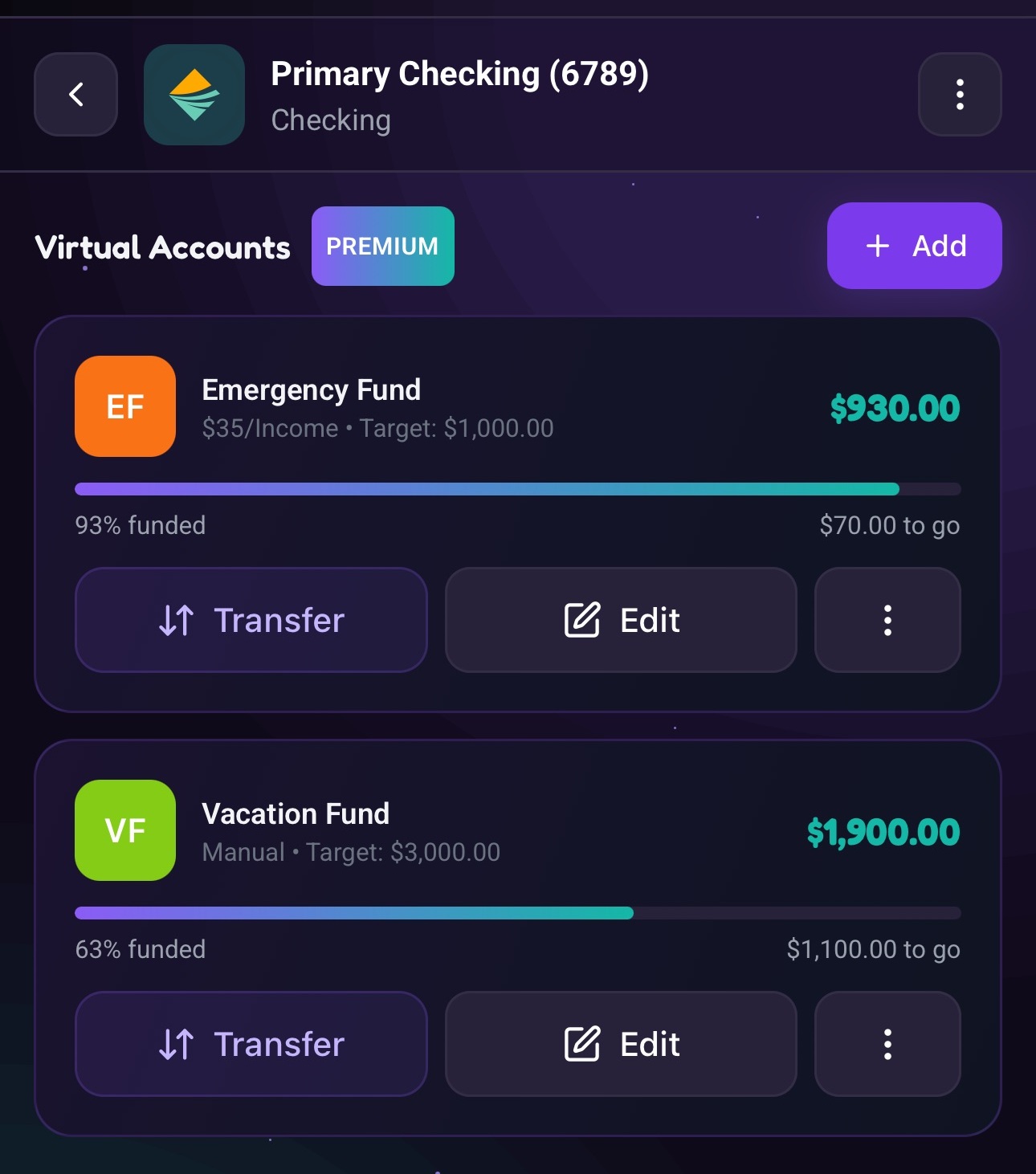
Three Ways to Fund Virtual Accounts
Virtual accounts are flexible. You can fund them however makes sense for your situation:
Manual Transfers (The Traditional Way)
You can manually move money in and out of virtual accounts whenever you want:
- Just got paid? Transfer $500 into your vacation fund
- Emergency expense? Pull $300 from your emergency fund
- Changed your mind? Move money between virtual accounts freely
This works great for one-time decisions or irregular income situations where you want full control over every dollar.
Automatic Funding Per Paycheck (The Smart Way)
This is where virtual accounts get powerful. Tell Pluto to automatically fund a virtual account with a specific amount each pay period:
Pluto will:
- Identify your income schedules linked to this bank account
- Reserve $200 from each paycheck automatically
- Track progress toward your $3,000 goal
- Stop funding once you hit the target
- Show you a progress bar so you always know where you stand
You set it once and forget it. Your vacation fund grows automatically without you thinking about it.
Hybrid Approach (The Realistic Way)
Most people use a combination:
- Emergency fund: Auto-fund $100/paycheck until it hits $5,000
- Vacation: Auto-fund $200/paycheck, no target (ongoing)
- Car repairs: Auto-fund $75/paycheck to maintain buffer
- Gift fund: Manual transfers when you think of someone's birthday
- Home maintenance: Auto-fund $150/paycheck to build reserves
You're automating the boring, predictable stuff while keeping flexibility for the unpredictable parts of life.
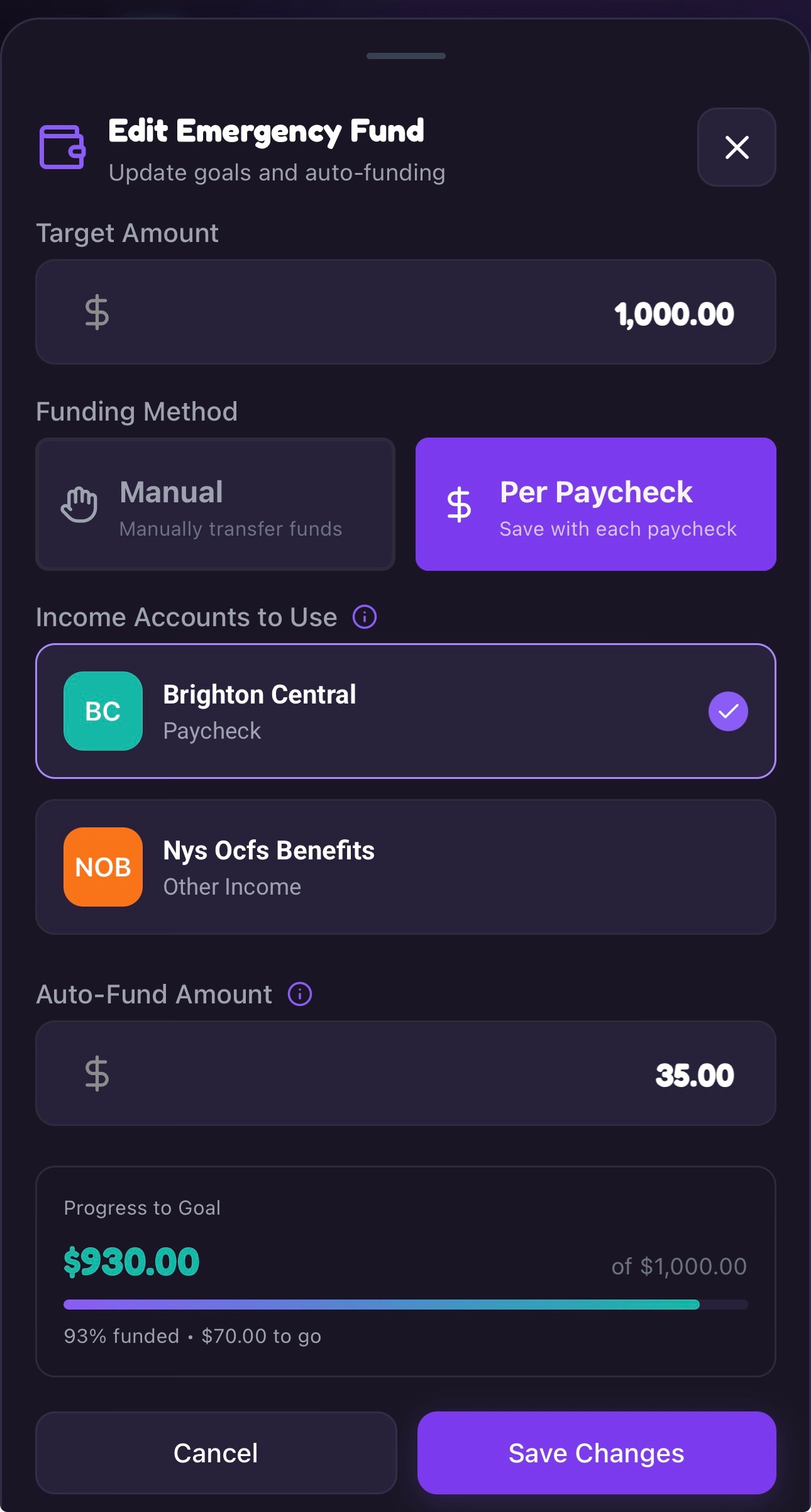
Progress Tracking: Visual Motivation
Every virtual account can have a target amount—a goal you're working toward. Pluto shows your progress visually with progress bars that fill up as you save.
Seeing the progress bar fill up creates positive momentum. You're not just saving abstractly—you're 84% of the way to your emergency fund goal. You're 46% toward that trip to Japan.
This is the psychological power of envelope budgeting brought to digital banking. Your money has purpose. Your savings have names. Your progress is visible.
Emergency Borrowing: The Safety Net Within the Safety Net
Here's where Pluto does something no physical envelope system could ever do: strategic borrowing during cash flow crunches.
Life happens. Sometimes you need to make a purchase that exceeds your current Safe to Spend, but you have money reserved in virtual accounts. Maybe your car needs an unexpected $800 repair, but you only have $400 in Safe to Spend. However, you've got $4,200 sitting in your emergency fund.
In traditional envelope budgeting, you'd raid the emergency envelope and hope you remember to pay it back. With Pluto, you can formally borrow:
- Create the expense: "Car repair: $800"
- Pluto shows the shortfall: "This exceeds your Safe to Spend by $400"
- Find the money: Borrow from Emergency Fund virtual account
- Automatic payback: Pluto schedules repayment from future paychecks
- Full transparency: You see exactly when the virtual account will be restored
This is the smartest kind of borrowing: from yourself, with full visibility, and automatic recovery.
Real-World Scenarios
Scenario 1: Building an Emergency Fund
Taylor has $1,200 in checking and wants to build a $5,000 emergency fund. Traditional advice says "save 3-6 months of expenses," which is overwhelming and abstract.
With virtual accounts:
- Create "Emergency Fund" virtual account
- Set target: $5,000
- Enable auto-funding: $150 per paycheck (bi-weekly)
- Pluto shows: "You'll reach your goal in 17 paychecks (8.5 months)"
Taylor doesn't think about emergency savings anymore. Every paycheck, $150 automatically goes into the virtual account. The progress bar fills up. Eight months later, Taylor has $5,000 saved without willpower or constant decision-making.
Scenario 2: Couples Saving for Different Goals
Alex and Morgan share a joint checking account but have different financial priorities. Alex wants to save for a house down payment. Morgan wants to build an adventure travel fund.
With virtual accounts in their shared bank account:
- Down Payment Fund (Virtual): Auto-fund $800/paycheck, target $40,000
- Adventure Fund (Virtual): Auto-fund $300/paycheck, target $5,000
- Joint Emergency (Virtual): Auto-fund $200/paycheck, target $10,000
- Safe to Spend: Whatever's left after all the auto-funding
Both partners can see all three goals progressing simultaneously. No arguments about whose priority matters more—they're funding both. The joint account serves everyone's needs.
Scenario 3: Seasonal Income
Casey works in education and has irregular income—good paychecks September through May, barely anything June through August. Casey needs to smooth out the cash flow volatility.
With virtual accounts:
- Summer Buffer (Virtual): Auto-fund $400/paycheck Sept-May, target $3,600
- During summer: Manually transfer from Summer Buffer as needed
- Safe to Spend reflects available money for normal expenses
Casey builds the buffer during high-income months and draws it down during low-income months. The virtual account makes this seasonal strategy explicit and trackable.
Why Virtual Accounts Beat Traditional Sub-Accounts
Some banks let you create multiple savings accounts or "goals" within your account. Why is Pluto's approach better?
Bank Sub-Accounts Are Isolated
Bank sub-accounts usually can't communicate with each other. You can't borrow from one to cover a shortfall in another without manual transfers and mental math.
Pluto's virtual accounts are aware of each other. You can borrow strategically, and Pluto tracks everything.
Bank Sub-Accounts Don't Connect to Spending
Your bank doesn't know when you need money from a sub-account. You have to manually transfer funds before making a purchase.
Pluto's virtual accounts are connected to your scheduled expenses and Safe to Spend calculation. If you have a bill due next week and the money is sitting in a virtual account, Pluto knows and factors it in.
Bank Sub-Accounts Don't Auto-Fund Intelligently
Most banks let you set up automatic transfers on specific dates. But they don't understand your income schedule or automatically stop at target amounts.
Pluto's auto-funding ties directly to your income schedules. "Fund $200 per paycheck" is smarter than "Transfer $400 on the 1st of every month" because it adapts to your actual pay timing.
Virtual Accounts Are Unlimited and Free
Most banks limit how many sub-accounts you can have (often 3-5). Some charge fees for additional accounts.
Pluto lets you create unlimited virtual accounts. Have 20 different savings goals? Go for it. They're all free.
Setting Up Your First Virtual Account (2 Minutes)
Ready to try it? Here's how:
- Pick a goal: What do you want to save for? Emergency fund? Vacation? Car repairs?
- Create the virtual account: Name it, set a target amount
- Decide funding method: Manual transfers or auto-funding per paycheck
- Watch it grow: Progress bar updates with each paycheck or manual transfer
That's it. You've just created a digital envelope for purposeful money.
Virtual Accounts Don't Replace Safe to Spend
This is important to understand: virtual accounts and Safe to Spend work together, not against each other.
Safe to Spend answers: "How much can I freely spend right now without compromising upcoming bills or reserved savings?"
Virtual Accounts answer: "Where is my reserved money going, and how am I progressing toward specific goals?"
They're complementary. Safe to Spend does the hard math of protecting you from overspending. Virtual accounts give structure and purpose to your savings.
The Anti-Guilt Savings Method
Traditional savings advice creates guilt. "You should have 6 months of expenses saved." "You need to max out your Roth IRA." "Where's your house down payment fund?"
All those "shoulds" without any practical "hows." No wonder people feel stressed about money.
Virtual accounts flip the script:
- Start where you are: $20/paycheck into an emergency fund is better than $0
- Progress is visible: 15% toward your goal is still progress
- No judgment: Pluto doesn't care if your target is $500 or $50,000
- Flexible adjustments: Change auto-funding amounts whenever life changes
You're not failing if you're not at 100%. You're winning because you're building purpose into your spending and saving. The progress bar doesn't lie, it just shows you where you are and celebrates how far you've come.
Common Questions
Do I need Premium to use virtual accounts?
No! Virtual accounts are available in Pluto's free tier. You can create unlimited virtual accounts, set targets, and manually transfer funds. Auto-funding from income schedules is also free.
Premium adds automatic transaction matching and bank connections, but the core virtual account features are free forever.
Can I have virtual accounts in multiple bank accounts?
Absolutely. Each real bank account (checking, savings, etc.) can have its own set of virtual accounts. This is useful if you keep different money in different places:
- Checking account: Emergency fund, vacation, car repairs
- High-yield savings: House down payment, long-term reserves
- Joint account: Shared goals with a partner
What happens if I overdraw a virtual account?
Virtual accounts can go negative if you borrow more than they contain. Since they still are part of the real parent bank account, that account's safe to spend will be affected by the difference once the virtual account transactions post.
Think of it like your emergency fund going to -$200 because you borrowed from it. The safe to spend on your bank account will just be reduced by that $200.
Can I delete a virtual account?
Yes, anytime. If the virtual account has a balance, it will just immediately go back to the parent bank account's safe to spend. You can then move it to another virtual account if you would like.
How is this different from YNAB's categories?
YNAB uses categories to divide your money conceptually across all accounts. You might have a "Vacation" category pulling from multiple bank accounts.
Pluto's virtual accounts are tied to specific real bank accounts. This keeps your Safe to Spend calculation accurate per account and prevents the "I have money in the budget but not in this account" problem.
Both approaches work, but virtual accounts make the per-account math clearer.
Virtual Accounts in Action
The real test of any budgeting tool is: does it actually change behavior?
With virtual accounts:
- You see your progress: Progress bars and target tracking create positive momentum
- You understand your reserves: No more vague sense of "I think I have enough saved"
- You stop raiding savings: Borrowing is explicit and tracked, not sneaky and guilt-inducing
- You automate good habits: Auto-funding means savings happen without willpower
- You handle emergencies better: Strategic borrowing from virtual accounts beats high-interest credit cards
This isn't just digital organization. It's psychological architecture for better money decisions.
Start Simple, Build Complexity
Don't create 15 virtual accounts on day one. Start with the obvious ones:
- Emergency fund (if you don't have one yet)
- Repair fund (auto and/or home, don't get caught off guard)
- One fun goal (save up for something you want, and don't use a credit card)
Get comfortable with three virtual accounts. Watch them fill up. See how the progress bars motivate you. Experience the relief of having money reserved when that irregular expense hits.
Then add more as you identify additional purposes.
The power of virtual accounts isn't in having 20 of them. It's in having the right ones—the envelopes that align with your actual financial life and goals.
The Envelope System, Evolved
Virtual accounts prove that old budgeting wisdom still works, you just need modern tools to make it practical.
Envelope budgeting was never wrong. It was just incompatible with digital banking. Until now.
Your money can have purpose. Your savings can have names. Your progress can be visible. And you never have to touch a single envelope or visit an ATM.
Sources and further reading
- Your Money, Your Goals toolkit (Consumer Financial Protection Bureau): worksheets for planning income, bills and spending.
- An essential guide to building an emergency fund (Consumer Financial Protection Bureau): how to build savings for expenses you did not see coming.
- Deposit Insurance (FDIC): how money held at a bank is insured.